

Can You Put Aluminum Foil in an Air Fryer? Yes—Follow 7 Safety Rules
The Short Answer: Yes, But With 7 Non-Negotiable Rules
Yes, you can put aluminum foil in an air fryer. Used correctly, foil is safe, saves cleaning time, and helps with certain recipes. Used carelessly, it can block airflow, touch the heating element, or start a fire. The difference comes down to seven non-negotiable rules.
Here is the complete list:
- Keep foil at least 2–3 inches away from the heating element.
- Make sure the foil is weighed down by food so it cannot blow around.
- Never crumple foil into loose, lightweight balls.
- Cover no more than half of the basket bottom.
- Never preheat an empty basket with foil inside.
- Avoid wrapping highly acidic foods in foil.
- Throw the foil away after one use and wipe the basket clean.
Foil will not melt in an air fryer: standard aluminum foil melts at about 660°C (1,220°F), while home air fryers max out around 200–230°C (400–450°F). The real risks are physical—foil is light, and the fan can move it where it should never go.
Why Air Fryers and Aluminum Foil Need Careful Handling
To understand why foil needs special handling, look at how the machine works. An air fryer is essentially a small convection oven. A heating element sits near the top of the cooking chamber, and a fan pushes hot air downward at high speed. That fast-moving air is what browns and crisps your food. You can read more about how hot air circulation works in an air fryer for the full technical picture.
That airflow is exactly what makes foil risky. A single sheet of foil is extremely light. When the fan starts, air can get underneath the sheet and lift it. If it flies up and touches the heating element, it can scorch, smoke, or ignite nearby grease. In ovens this rarely happens because the fan is slower and the chamber is larger. In an air fryer, the air moves fast and the space is compact, so even a small piece of foil can become a hazard.
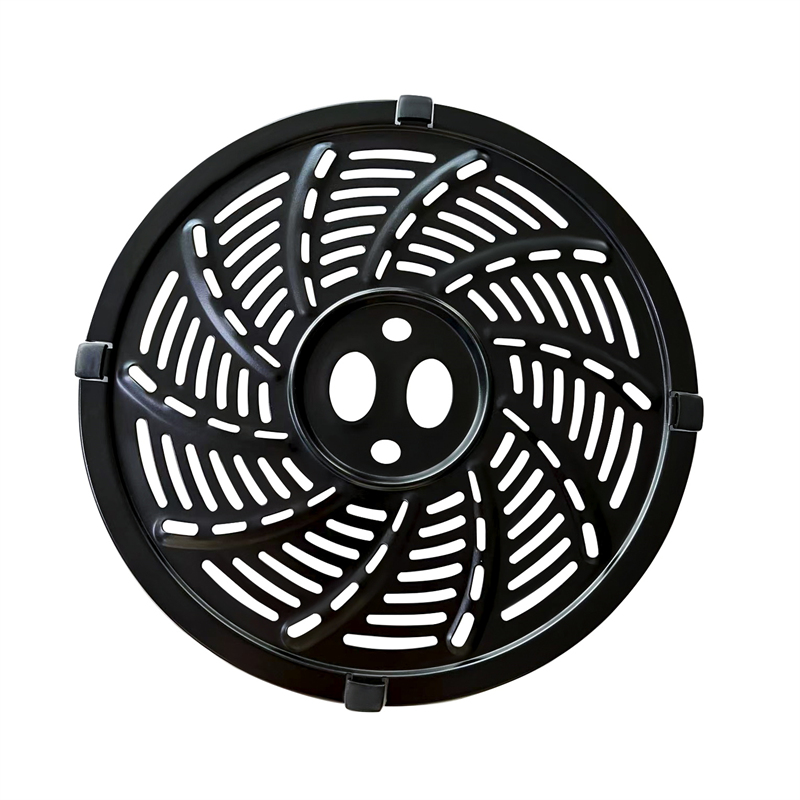
Foil also changes how air reaches your food. The basket bottom has perforations that let hot air hit the underside of the food. If foil blocks those holes, the underside cooks differently. And because foil reflects heat, covered areas behave differently from uncovered ones. None of this makes foil unusable—it just has to be placed deliberately.
Best Ways to Use Aluminum Foil in an Air Fryer
Placed with intention, foil is a genuinely useful tool. Here are the three scenarios where we recommend it.
Line the Basket to Catch Drips and Oil
For fatty foods like chicken wings, bacon, or sausages, a small sheet of foil under the food catches rendered fat and makes cleanup dramatically easier. Lay a flat sheet on the basket floor, fold the edges up slightly to form a shallow tray, and keep the foil area to half the basket or less. The food must sit directly on the foil, covering it fully. The weight of the food is what keeps the foil in place.
Wrap Food in a Foil Packet
Fish fillets, vegetables, and anything you want to keep moist cook well inside a sealed foil packet. Wrap the food completely, fold the seams tightly, and place the packet seam-side up in the basket. A properly sealed packet is heavy enough to stay put. Remember that a packet traps steam, so the outside of the food will not crisp the way it would on an open rack. That is a feature for delicate foods and a drawback for fries.
Cover Foods That Splatter or Spit
Cheese-topped dishes and tomato-based ingredients can spit during cooking. Drape a loose sheet of foil over the food as a splatter guard, but tuck it under the food on at least two sides. If the foil only rests on top, the fan can peel it back and send it flying toward the heating element.
Mistakes That Can Damage Your Air Fryer or Cause a Fire
Most foil-related incidents come from a small set of repeatable mistakes. Here is what to avoid and what can happen.
- Preheating an empty basket with foil inside. With no food holding it down, the foil lifts the moment the fan starts and can contact the heating element. If you preheat, add foil only after the basket is in place with food on top.
- Leaving foil exposed under the heating element. Any foil that is visible and uncovered is a risk. If you cannot cover the foil with food, do not use foil.
- Using wrinkled, torn, or recycled foil. Old foil has sharp folds and weakened spots. A torn edge can separate during cooking and float into the heating chamber. Start with a fresh sheet every time.
- Pushing foil into gaps around the basket. Foil that slips between the basket and the machine housing can block the fan or touch internal wiring. Check the basket rim before you start.
- Covering the entire basket floor. With the whole bottom lined, hot air cannot pass through the perforations. The fan struggles, the machine may overheat, and food cooks unevenly. Keep foil coverage to roughly half the surface.
Modern air fryers are built with multiple layers of protection. Many of our machines include the overheating protection features in air fryers, such as thermal cutoffs that shut the unit down before a small mistake becomes serious. A smart 5L digital air fryer with 8 presets, for example, carries international safety certifications including CE, CB, GS, ETL, FDA, ROHS, and LFGB. But protection circuits are a backup, not a license to ignore the rules.
Does Foil Affect Cooking Results?
Yes. Foil changes how heat reaches food, depending on where you put it.
If you line the bottom, the underside may not crisp. A sheet of foil blocks the hot air that would otherwise hit the food from below, so the area in direct contact with foil stays softer. This is often fine for chicken thighs or meatloaf, but it is the reason foil-wrapped fries turn out limp on the bottom.
If you wrap food completely, you create a steaming environment. The sealed packet traps moisture, which keeps fish and vegetables juicy but prevents the surface from drying out and crisping. If your goal is maximum crunch, skip the packet. If your goal is tender, evenly cooked protein, a packet is excellent.
Cooking time can shift slightly because foil reflects heat, so the top of the food may cook faster while the bottom lags. Check for doneness a few minutes early the first time you use foil. To see the effect yourself, cook one batch of fries directly in the basket and another on foil—the contrast in bottom crispness will be obvious.
Aluminum Foil vs. Parchment Paper vs. Silicone Mat
Foil is not your only option. Parchment paper and silicone mats are popular alternatives, and each one behaves differently in an air fryer. Here is how they compare.
| Material | Heat Tolerance | Airflow | Sticking | Reusable? |
|---|---|---|---|---|
| Aluminum foil | Up to about 660°C; far above air fryer limits | Blocks perforations if covering too much area | Food sticks easily; no nonstick coating | No; use once and discard |
| Parchment paper | Usually 200–230°C; check the brand label | Blocks airflow and is lighter than foil | Good nonstick performance | No; use once and discard |
| Silicone mat | Typically up to 230°C | Thicker; reduces basket capacity slightly | Excellent nonstick performance | Yes; wash and reuse |
For catching drips from fatty meat, foil is the most practical choice because it holds a folded shape. For anything that tends to stick, parchment paper or a silicone mat is better—foil has no nonstick surface and can tear when you pull food off it. Parchment paper is very light, so weigh it down with food just like foil, and never let it sit in an empty preheating basket. Silicone mats are the most durable, but their thickness reduces the usable basket volume, which matters more in compact machines.
The type of machine you own also changes which liner makes sense. Our guide to basket-style air fryers vs. air fryer ovens explains the structural differences that affect liner choice, cleaning habits, and cooking capacity.
Manufacturer's Note: How Air Fryer Design Affects Foil Safety
As a manufacturer, we design air fryers around airflow, and not every design handles foil the same way. Knowing which type you own helps you judge how careful you need to be.
Heating element placement matters most. In most basket-style air fryers, the element sits at the top and the fan blows air downward, so lifted foil travels upward toward it. In models with different placement, the danger zone moves, but the principle stays the same: keep foil away from any hot surface and out of the fan's path.
Models with a viewing window need extra attention. Loose foil can drift against the glass and block your view, and in some designs the window sits close to the fan housing. A 5L digital air fryer with a viewing window lets you monitor food without opening the basket, but only if the foil stays anchored beneath the food. Check through the glass early in the cycle to confirm nothing has shifted.
Air fryer ovens behave more like traditional ovens. With heating elements at the top and bottom, a bigger chamber, and slower airflow, foil is less likely to blow around. Still, do not line the entire tray—blocking airflow ruins the convection effect. A 15L visible air fryer oven offers the wide trays and tall chamber that make foil packets and partial liners work well, but the half-surface rule still applies. Whatever your machine type, the seven rules above are the baseline; your model only changes how strictly you apply them.
Final Verdict: What to Do Every Time You Reach for the Foil
Here is the simplified checklist we give our customers. Follow it and you will be safe.
Do:
- Use a fresh sheet of foil each time.
- Keep foil coverage to half the basket or less.
- Make sure food sits on top of the foil and covers it.
- Leave at least 2–3 inches between foil and the heating element.
- Discard the foil and wipe out the basket after cooking.
Don't:
- Don't preheat an empty basket with foil in it.
- Don't crumple foil into loose balls or use torn pieces.
- Don't line the entire basket bottom.
- Don't wrap highly acidic foods, like lemon-marinated fish, for long cooks.
- Don't run the air fryer on high with exposed foil and no food on top.
Aluminum foil is a convenience, not a requirement. When in doubt, skip the foil and cook directly on the basket. A few extra minutes of scrubbing is a fair trade for a trouble-free cook.