
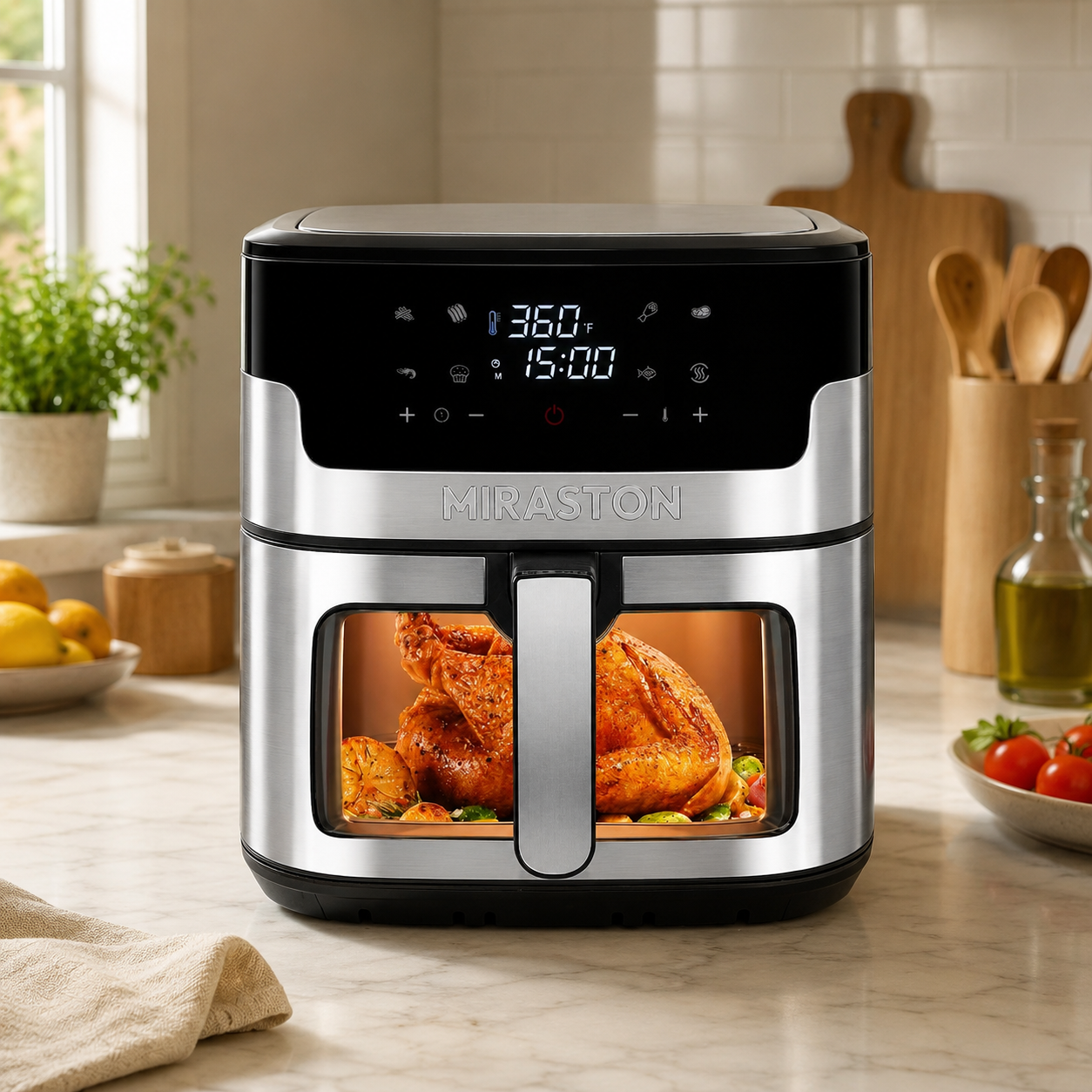
Is an Air Fryer the Same as a Convection Oven
Is an Air Fryer a Convection Oven, and Which Appliance Is Better?
Questions such as is an air fryer a convection oven, is a convection oven the same as an air fryer and is an air fryer the same as a convection oven are common because both appliances use heated, moving air. Their cooking principles are related, but their chamber size, fan speed, airflow concentration and practical applications are not identical.
An air fryer can be described as a compact, high-intensity convection cooking appliance. A convection oven is generally larger and designed for broader baking, roasting and multi-rack cooking. An air fryer oven sits between these two categories by combining a larger oven-style chamber with a stronger air-circulation mode.
Why Air Fryers and Convection Ovens Appear Similar
A standard oven heats food mainly through a combination of radiant heat from the heating elements and natural air movement inside the chamber. A convection oven adds a fan that circulates heated air, reducing temperature differences and helping food cook more evenly.
An air fryer uses the same basic idea but intensifies it. The fan is usually positioned close to the heating element, and the cooking basket sits within a relatively small chamber. Heated air moves rapidly around and through the food, removing surface moisture and accelerating browning.
Heating
An electric element raises the air temperature near the top or rear of the chamber.
Air Acceleration
A fan pushes heated air through a concentrated circulation path.
Surface Drying
Moving air removes moisture from the outside of the food.
Browning
Dryer surfaces brown faster and can develop a crisp texture.
An air fryer is a type of forced-convection cooker, but not every convection oven performs like an air fryer. Air velocity, chamber volume and the distance between the food and heating system determine the actual result.
Is a Convection Oven the Same as an Air Fryer?
The direct answer to is a convection oven the same as an air fryer is no. The appliances share convection technology, but their structures are optimized for different cooking priorities.
Searches using the wording is convection oven same as air fryer or is a air fryer a convection oven usually reflect the same concern: whether one appliance can completely replace the other. Replacement is possible for some foods, but not for every cooking task.
Compact Chamber and Strong Airflow
Larger Chamber and Broader Cooking Space
| Comparison Factor | Basket Air Fryer | Air Fryer Oven | Convection Oven |
|---|---|---|---|
| Typical chamber format | Drawer and basket | Front-opening oven chamber | Full oven cavity |
| Airflow concentration | Very concentrated | Concentrated to moderate | Moderate |
| Heating response | Fast | Fast to medium | Medium |
| Batch capacity | Low to medium | Medium | High |
| Food visibility | Limited during cooking | Usually visible through door | Visible through oven door |
| Multi-level cooking | Rare | Often available | Common |
| Counter space | Low to medium | Medium to high | Built-in or high |
How Cooking Results Differ in Real Use
The statement is an air fryer the same as a convection oven cannot be answered only by examining the fan. Food arrangement, tray design and usable surface area are equally important.
The performance bars illustrate typical use characteristics rather than laboratory ratings. Actual results depend on appliance power, chamber geometry, food quantity and temperature control.
Which Is Better, an Air Fryer or an Air Fryer Oven?
The question Which is better, an air fryer or an air fryer oven? should be answered according to portion size and cooking habits. A basket-style air fryer prioritizes speed and concentrated airflow. An air fryer oven provides more space and cooking flexibility but normally occupies a larger area.
For Fast Daily Portions
This format is suitable for one to three users who frequently prepare fries, chicken wings, vegetables, bacon, fish portions and reheated food.
For Capacity and Versatility
This format is suitable for users who need several rack positions, wider trays and the ability to toast, bake, roast, dehydrate or cook larger quantities.
Efficient for regular small portions and limited countertop space.
A wider chamber accommodates baking trays and small cake molds.
A full-size chamber handles larger cookware and higher food volumes.
A balanced option for crisping, toasting, roasting and reheating.
Is It Worth Getting an Air Fryer Oven?
The answer to Is it worth getting an air fryer oven? depends on whether the appliance replaces other countertop equipment or simply adds another large unit to the kitchen.
An Air Fryer Oven Is Worth Considering When:
Wider trays can hold toast, pizza slices, chicken portions and vegetables without deep stacking.
Many oven-style units support air frying, baking, roasting, toasting and dehydration.
A transparent door allows food color and browning to be checked without removing a drawer.
Flatbread, small pizzas, toast and baking molds fit more naturally in an oven-style chamber.
Your existing convection oven already performs well and additional speed is not important.
You usually prepare only one small portion and a basket appliance would use less countertop space.
The kitchen cannot provide sufficient ventilation clearance around a larger countertop appliance.
Multi-function settings would rarely be used in daily cooking.
Are Ovens with Built-In Air Fryers Any Good?
The question Are ovens with built-in air fryers any good? requires attention to the difference between a dedicated air fryer and an oven that includes an air-fry cooking mode.
A built-in air-fry function normally operates the convection fan at a higher speed and may use a perforated tray to improve airflow beneath the food. This can produce better crisping than a standard baking mode, particularly when the food is arranged in a single layer.
High Cooking Capacity
Full-size oven space can handle more food than most countertop appliances, making it useful for family meals and larger trays.
No Additional Countertop Unit
The air-fry setting is integrated into an appliance that already occupies the oven position.
Longer Preheating
A full oven cavity takes more time and energy to reach cooking temperature than a small air fryer chamber.
Less Concentrated Airflow
The larger chamber may not create the same rapid surface drying produced by a compact basket air fryer.
How to Improve Built-In Air-Fry Results
Use a perforated metal tray or basket that allows heated air to reach the lower surface of the food.
Avoid placing too many pieces on one tray. Crowding traps moisture and reduces browning.
Position a drip tray below fatty food while preserving enough space for air circulation.
Rotate the tray when the oven has noticeable front-to-back temperature differences.
What Are the Disadvantages of Air Fryer Oven Appliances?
Users asking What are the disadvantages of air fryer oven? should evaluate space, cleaning effort, heat distribution and expected cooking speed before selecting an oven-style model.
Larger Countertop Footprint
An air fryer oven usually requires more width and depth than a drawer-style air fryer. Additional clearance is also needed around the air outlet and front-opening door.
More Components to Clean
Racks, trays, crumb collectors, door glass and chamber walls may all collect grease or food residue.
Possible Rack-Level Differences
Food placed close to the upper heating element may brown faster than food on a lower rack. Tray rotation may be necessary.
Longer Heating Than a Small Basket
A larger chamber generally takes more time to heat and recover temperature after the door is opened.
Higher External Heat Exposure
Larger side panels and glass doors can release more heat into the surrounding kitchen area.
More Complex Controls
Multiple cooking modes can improve flexibility but may require more time for users to understand temperature, rack and accessory combinations.
Important Specifications for an Air Fryer Oven
Product capacity should not be evaluated only by the stated liter value. Internal width, rack spacing, door opening angle and usable tray area directly affect the type and quantity of food that can be prepared.
Core Parameters
Balanced product design connects heating power, chamber size, fan performance and insulation. Increasing one specification without adjusting the others may not improve cooking quality.
| Specification | Evaluation Point |
|---|---|
| Usable chamber dimensions | Confirm whether trays, toast slices, pizza and baking molds can fit without blocking airflow. |
| Rated power | Power should match chamber size and expected heating speed. |
| Fan and airflow design | Even air distribution helps reduce hot spots and rack-level differences. |
| Heating element arrangement | Upper and lower heating support broader baking and roasting applications. |
| Door insulation | Suitable glazing and sealing help reduce external heat and energy loss. |
| Accessory set | Air-fry basket, baking tray, wire rack and crumb tray extend practical use. |
| Cleaning access | Removable trays and accessible chamber surfaces reduce maintenance difficulty. |
| Safety protection | Overheat protection, automatic shut-off and stable feet support safer operation. |
Multiple Rack Positions
Adjustable levels support different food heights and allow the cooking distance from the heating element to be controlled.
Removable Crumb Tray
A lower collection tray simplifies the removal of crumbs, oil droplets and small food particles.
Independent Heating Control
Separate upper and lower heating options can improve baking, roasting and final surface browning.
Interior Lighting
Chamber lighting allows users to inspect food without frequently opening the door and losing heat.
Clear Digital Interface
Visible temperature, time and mode information helps reduce setting errors during daily operation.
Regional Configuration
Rated voltage, frequency, plug type, control language and packaging can be prepared for different destination requirements.
Installation, Ventilation and Cleaning Details
Countertop Placement
Place the air fryer oven on a level, dry and heat-resistant surface. The rear, upper and side ventilation areas should remain unobstructed. The front door must have enough space to open fully without contacting nearby objects.
Hot Surface Awareness
The glass door, upper housing and ventilation outlet may become hot during operation. Heat-resistant gloves should be used when removing trays or racks.
Grease Management
Fatty food should be positioned above a suitable collection tray. Old grease residue can create smoke and odor during later cooking cycles.
Disconnect the appliance and allow the chamber to cool.
Wash trays and racks with warm water and mild detergent.
Wipe with a soft damp cloth without soaking electrical parts.
Keep ventilation areas free from dust and grease buildup.
Air Fryer and Convection Oven FAQ
An air fryer is a compact forced-convection appliance. It uses rapidly moving heated air, but its smaller chamber and concentrated airflow create different cooking behavior from a standard convection oven.
No. Both circulate hot air, but a convection oven normally has more capacity, lower airflow concentration and a longer heating period.
It can prepare many of the same foods, especially when a perforated tray and high fan setting are used. Small portions may take longer and may not become equally crisp.
Many air fryer ovens include toast, bake and reheat settings. Suitability depends on chamber width, heating control and the number of toast slices required.
Preheating is recommended for baking, meat browning and temperature-sensitive recipes. Some frozen foods and reheating tasks can begin without a separate preheating cycle.
The upper rack may receive stronger radiant heat while the lower rack receives less direct airflow. Swapping or rotating trays can improve consistency.
No. A larger chamber increases capacity but may require more heating time, countertop space and cleaning effort. Usable tray dimensions are often more important than total volume.
Fries, chicken wings, breaded food, roasted vegetables, bacon and reheated fried food benefit from rapid surface drying and concentrated hot-air circulation.