
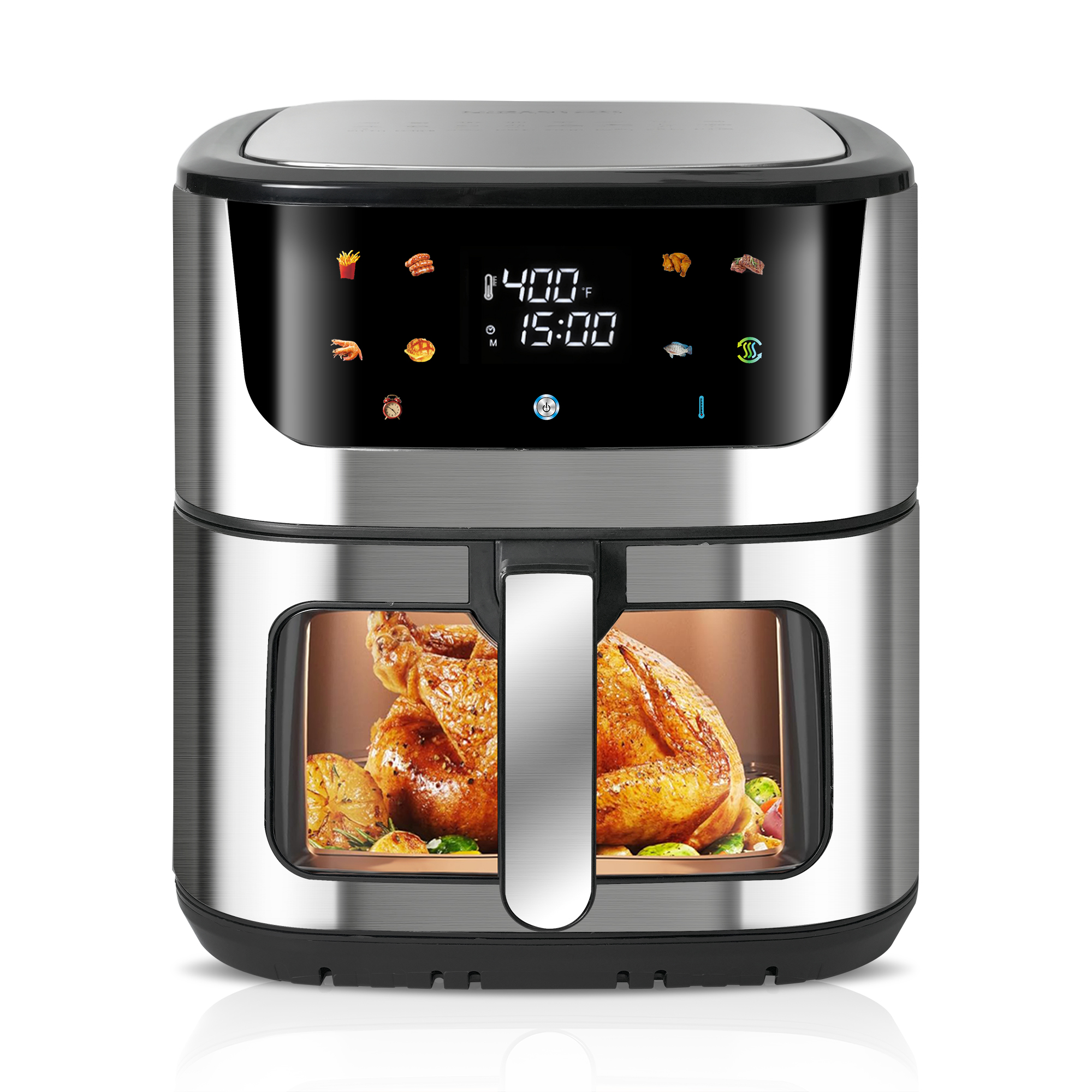
Is it really worth buying an air fryer
Core Working Principle: Why Is It Called an "Air" Fryer?
Although the name contains the word "fry," air fryers do not require submerging food in oil. Its essence is a high-efficiency small convection oven with a powerful fan.
Rapid Air Technology
The core of air fryers lies in the heating element at the top and the powerful fan above it.
- Thermal Convection: The heating tube generates high temperatures (usually up to 200°C), and the fan blows hot air downward at a very high speed toward the food.
- 360° Circulation: The hot air bounces off the hollow bottom of the basket, creating a rapid circulation of airflow within the small, sealed space.
- Maillard Reaction: This high-speed hot air quickly removes moisture from the food surface, promoting the "Maillard reaction," which creates a crispy texture and golden color similar to deep-frying.
Parameter Comparison: Air Fryer vs. Traditional Oven
To understand the efficiency of air fryers more intuitively, we can compare them through the following key technical parameters:
| Performance Parameters | Air Fryer | Traditional Household Oven |
| Heating Principle | Top heating tube + high-speed fan convection | Top/bottom heating tube radiation + natural convection |
| Airflow Speed | Extremely high (several times that of a regular oven) | Very low (even with a fan, the speed is slower) |
| Internal Volume | 3L - 10L (small volume, concentrated heat) | 30L - 60L (large volume, slow temperature rise) |
| Preheating Time | 0 - 3 minutes (basically no preheating required) | 10 - 20 minutes (long waiting time required) |
| Cooking Speed | 20% - 30% faster than an oven | Slower |
| Power Consumption | 800W - 1800W (less electricity per single use) | 2000W - 5000W (large heat loss during startup) |
Five Core Reasons to Buy an Air Fryer
Healthier with Less Oil: Significant Reduction in Fat Intake
This is the most attractive advantage of air fryers. Compared to traditional deep-frying, air fryers require very little oil (or even no oil) to achieve a crispy effect.
- De-oiling Effect: Forced high-speed hot air carries away the natural fats from meat and prevents food from absorbing large amounts of external grease like deep-frying does.
- Reduction of Harmful Substances: Studies show that using air fryers to cook starchy foods (like fries) can reduce the production of acrylamide (a potential carcinogen) by up to 90% compared to deep-frying.
Extreme Efficiency and Time-Saving: A Savior for Fast-Paced Life
Air fryers are much faster than traditional appliances for daily meals:
- No Preheating Needed: Because the chamber is small and the wind power is strong, most air fryers can reach the set temperature within 1-3 minutes.
- Shortened Cooking Time: On average 20% - 30% faster than an oven.
Energy Efficiency Comparison: Saving Money and Environment
In terms of energy consumption, air fryers show high cost-performance, especially when handling small portions.
| Energy/Health Parameters | Air Fryer | Deep Fryer | Electric Oven |
| Average Oil Usage | 1 tsp - 1 tbsp (5-15ml) | Requires submersion (500ml - 1L+) | Brush a small amount (10-20ml) |
| Fat Reduction | Up to 70% - 80% | 0% (Baseline) | Slight reduction |
| Operating Power | 1400W - 1800W | 1500W - 2500W | 2500W - 5000W |
| Electricity Used | Approx. 0.4 - 0.7 kWh | Approx. 0.8 - 1.2 kWh | Approx. 1.5 - 2.5 kWh |
Kitchen Space Savior: Multi-Purpose Machine
Air fryers are more than just fryers; they can partially replace the following appliances:
- Microwave Alternative: When reheating leftovers like fried chicken, pizza, or fries, air fryers restore crispiness, whereas microwaves make food soggy.
- Multifunctional Cooker: Modern air fryers generally have functions for baking, dehydrating (making dried fruit), searing steaks, and even proofing dough.
Low Barrier to Entry: A "Fail-Proof" Tool for Beginners
- Simple Operation: Most are equipped with one-touch presets for "fries," "wings," and "steak."
- High Tolerance: The automatic shut-off timer prevents kitchen accidents caused by forgetting to turn off the heat, which is vital for those not skilled in cooking.
Practical Limitations of an Air Fryer
Capacity Limits: The Bottleneck for Family Gatherings
The compact design of air fryers is a double-edged sword.
- Batch Cooking: For families of more than 4, it is difficult to cook a full portion of chicken drumsticks or steaks at once.
- Stacking Affects Texture: To ensure crispiness, food should not overlap in air fryers. Overfilling the basket blocks airflow, leading to soggy food.
Cleaning Challenges: Hidden Grease Dead Zones
While many components are labeled "dishwasher safe," actual cleaning is not always easy:
- Heating Tube Buildup: The heating tube above the fan is at the top; oil splashes accumulate over time and are extremely hard to reach and clean.
- Basket Gaps: The mesh of the hollow basket and the joints of the rack easily hide dirt, which can produce odors if not scrubbed timely.
Texture Discrepancy: Cannot Fully Replace Traditional Frying
If you are a fan of "deep frying," air fryers might disappoint you:
- Dryness: Because the principle is hot air blowing, certain ingredients may appear dry and hard if not brushed with extra oil, lacking the heavy aroma of traditional frying.
- Wet Batter Restrictions: Wet batters (like Japanese Tempura) will drip directly in air fryers and cannot set instantly like they do in hot oil.
Parameter Comparison: Air Fryer vs. Traditional Oven (Limitations)
| Limitation Dimension | Drawer-style Air Fryer | Large Electric Oven |
| Max Capacity | 2L - 8L (1-4 people) | 30L - 70L (Roast whole turkey) |
| Space Distribution | Narrow vertical space | Open space, fits large molds |
| Cleaning Complexity | Heating tube hard to clean | Large space easy to wipe |
| Cooking Uniformity | Extremely uniform for small portions | More stable for large portions |
| Moisture Retention | Moisture lost easily, drier | Better retention of meat juices |
Who Is an Air Fryer Best Suited For?
Singles or Couples
For small households that don't often cook "grand feasts," the usage frequency of air fryers is extremely high.
- Portion Matching: Perfect for 1-2 people.
- Effort Saving: No need to move heavy cookware for a quick meal, and only one basket to wash.
Efficiency-Seekers in a Fast-Paced Life
- Reheating Meals: Air fryers are the best solution for reheating takeout (especially pizza and fried foods).
- Simultaneous Cooking: While stir-frying on the stove, an air fryer can independently complete a main roast dish.
Health-Conscious and Weight-Loss Groups
- Fat Substitution: Air fryers can force out the natural oil from meats like pork belly or skin-on chicken thighs, achieving "frying with its own oil."
- Vegetable Dehydration: Uses minimal oil to create "dry-fried" effects for vegetables like green beans.
Comparison of User Scenarios
| Feature | Singles/Couples | Large Families (4+) | Fitness/Dieting | Professional Bakers |
| Recommended Size | 3L - 4L | 6L - 10L | Approx. 5L | Not Recommended |
| Core Use | Quick dinner, reheating | Side dishes, fries | Chicken breast, lean meat | Small snacks occasionally |
| Usage Frequency | Extremely High | Medium | High | Low |
| Space Sensitivity | High | Low | Medium | High |
Kitchen "Gadget Lovers" and Space-Limited Users
- Substitute Attribute: For renters, an air fryer can handle 80% of oven tasks and is more portable.
- Complementary Function: Even if you have a large oven, air fryers are valuable for items "not worth the effort of starting the big oven."
FAQs
Q: Is an Air Fryer really more energy-efficient than an oven?
A: Yes, especially for small portions. Although the rated power (usually 1200W - 1800W) is high, because the chamber is small, requires no preheating, and cooks 20% faster, the actual electricity consumption is usually only 1/2 to 1/3 of a large oven.
Q: Can I put aluminum foil or parchment paper in an Air Fryer?
A: Yes, but it must be used correctly.
- Don't block airflow: Foil should not cover the entire bottom, or it will affect crispiness.
- Never use while empty: Never put paper in during preheating without food, as the fan will suck the paper into the heating tube, causing a fire.
Q: Does food cooked in an Air Fryer cause cancer?
A: This is a common misconception. Any high-temperature cooking (above 120°C) can produce acrylamide. However, air fryers are not the culprit. In fact, by reducing the repeated high-temperature heating of oil, air fryers are actually safer than traditional deep-frying.
Key Parameters: Efficiency and Safety Comparison
| Dimension | Air Fryer | Microwave | Household Oven |
| Heating Method | Forced Convection | Electromagnetic Waves | Slow Convection/Radiation |
| Reheat Texture | Crispy, near fresh | Soggy, chewy | Good, but very slow |
| Radiation Interference | Extremely Low | High | Extremely Low |
| Safety Risks | Oil buildup on tube | No metal allowed | High external surface temp |
| Time (Reheat Pizza) | 3 - 5 Minutes | 1 - 2 Minutes | 10 - 15 Minutes |
Q: If I already have a convection oven, do I still need one?
A: It depends on the scenario. If you frequently cook "meals for one" or small portions of fries for children, the instant-on experience of air fryers is far better. However, if you primarily cook whole chickens or multi-layer cookies, a convection oven already covers the core principles of air fryers.