
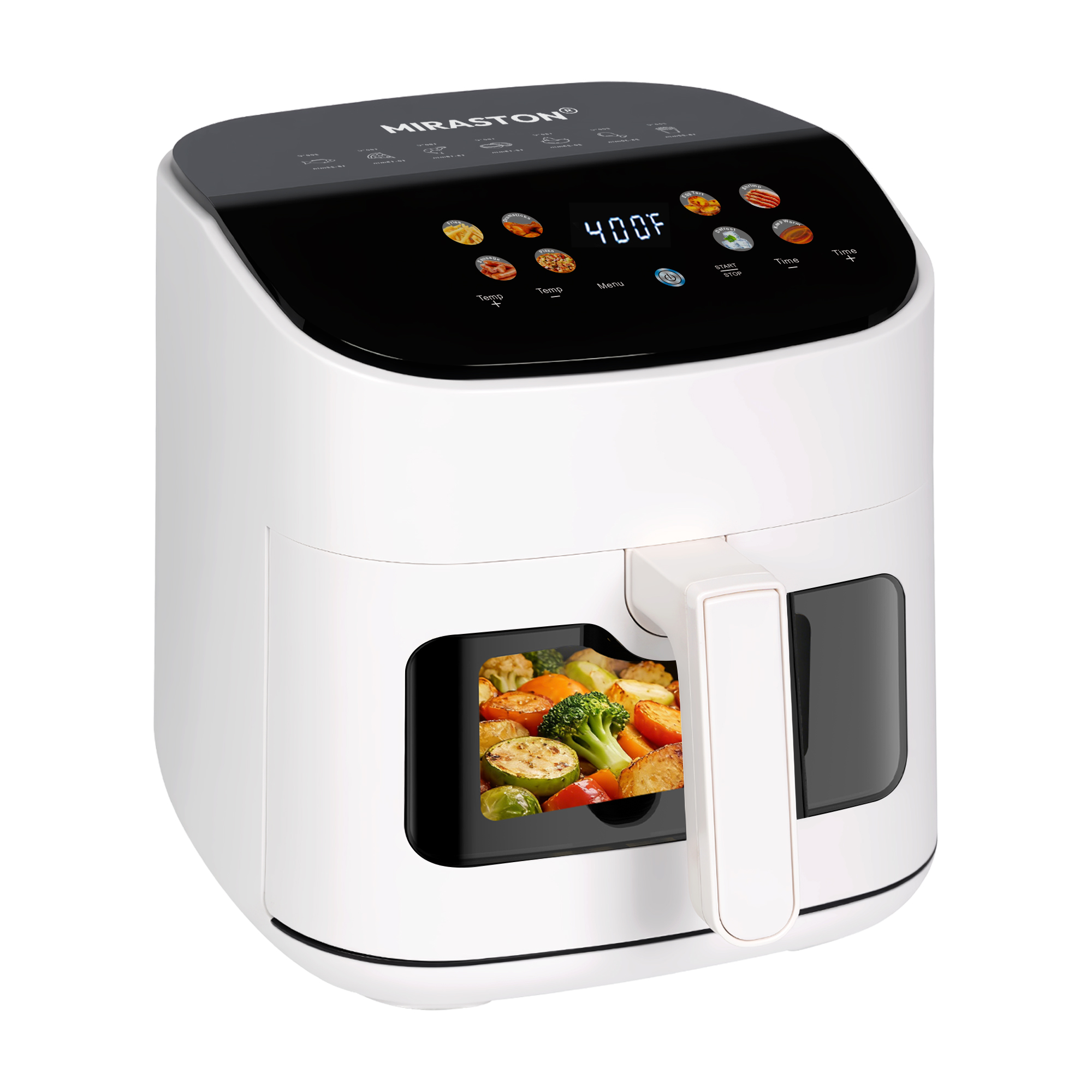
What Is a Digital Air Fryer and How Do You Use One
Digital Air Fryer Manufacturing: Engineering, Usage and Quality Standards
A digital air fryer is no longer a simple kitchen gadget assembled from generic parts. Behind every unit that reaches a distributor's warehouse is a production chain involving mold design, circuit board calibration, heating element testing and multiple rounds of safety verification. This page walks through the engineering logic, the daily operation process, and the manufacturing standards that separate a reliable digital air fryer from a short-lived one, giving buyers a clearer picture of what actually happens on the factory floor before a unit is packed into a carton.
Core Engineering Behind Every Unit
Every digital air fryer produced on our lines starts with a printed circuit board designed in-house by our electronics engineering team. This board governs temperature sampling, fan speed regulation, and timer accuracy. Unlike mechanical dial-based units, a digital control board reads real-time temperature feedback from a thermistor sensor placed near the heating chamber, adjusting power output multiple times per second to keep the cooking chamber within a narrow temperature band. This is the same principle that answers the frequent buyer question of how do you use a digital air fryer to get consistent results batch after batch — the consistency does not come from the user's skill, it comes from the board's feedback loop.
Heating Module
Ring-shaped heating tube positioned above the basket, rated for a stable output across repeated thermal cycles without warping.
Control Board
Surface-mounted components soldered under reflow ovens, tested individually before installation into the housing.
Fan Assembly
Balanced blade design reduces vibration and keeps airflow directional so hot air reaches every layer of food evenly.
Display Interface
Touch panel or button panel bonded with waterproof film to resist steam and oil splashes during daily kitchen use.
Operating Sequence: How Do You Use a Digital Air Fryer Correctly
A common source of after-sales inquiries is improper operation rather than product defects, so we document the correct sequence for every unit shipped. The steps below reflect what our quality team verifies during final functional testing before packaging.
Dry the Basket Before Power On
Residual water on the non-stick coating can cause steam bursts once the heating tube activates. Every unit leaving the factory is tested dry for this exact reason.
Select a Preset or Manual Mode
Preset programs are calibrated against real ingredient weights during R&D testing, not estimated values, so the fries, wings, or vegetable presets reflect actual cook data.
Allow the Preheat Cycle to Complete
Skipping preheat is the leading cause of uneven browning reported by end users, even though the unit itself is functioning within spec.
Shake or Flip Midway
Pausing the cycle does not reset the timer on a properly engineered digital air fryer; the countdown resumes from where it stopped.
Cool Down Before Cleaning
The control board compartment is sealed against splashes but not designed for submersion, so cleaning should be limited to the basket and inner pot.
What's the Difference Between an Air Fryer and a Digital Air Fryer
Buyers sourcing for retail shelves frequently ask what's the difference between an air fryer and a digital air fryer beyond the obvious display panel. From a manufacturing standpoint, the difference runs through component selection, tooling cost, and testing protocol. The table below lists the attributes our engineering team evaluates when quoting a mechanical dial unit against a digital control unit.
| Attribute | Mechanical Air Fryer | Digital Air Fryer |
| Temperature Sensing | Fixed bimetallic switch | Thermistor with continuous feedback |
| Multi-Stage Cooking | Not supported | Supports sequential temperature changes in one cycle |
| Auto Shutoff Accuracy | +/- 3 to 5 minutes drift | Second-level accuracy via timer chip |
| Child Lock Function | Rarely available | Standard on most control boards |
| Recipe Memory | None | Stores last-used settings on select models |
| Tooling Complexity for Production | Lower, fewer components | Higher, requires PCB assembly line |
| Typical Unit Testing Time | Shorter functional check | Extended check including software response test |
What Is the Use of a Digital Air Fryer on a Production and Retail Level
Beyond the household kitchen, the question of what is the use of a digital air fryer also matters to buyers building a product catalog. A digital control system allows the same hardware platform to be reprogrammed with different preset icons, different language displays, and different wattage configurations for different target markets, without redesigning the entire mold. This flexibility is why many retail brands request digital control units even when a mechanical version would be cheaper to produce.
Market-Specific Presets
Preset icons and cook programs can be adjusted to reflect regional cooking habits, such as different default programs for fish, pastry, or root vegetables.
Voltage Flexibility
The same board design can be configured for 120V or 220-240V input, allowing one production line to serve multiple export regions.
Language Localization
Display text and preset labels can be localized without changing the internal heating and fan assembly.
Private Label Branding
Control panel graphics, packaging artwork, and instruction manuals can carry a buyer's own brand identity through the OEM production process.
Why Are People Ditching Air Fryers: Root Causes and Engineering Responses
Reports asking why are people ditching air fryers usually point to a handful of recurring complaints. On the factory side, these complaints are treated as design feedback rather than dismissed as user error, since consistent complaint patterns typically indicate a component or tolerance issue that needs correction in the next production run.
Basket Coating Wear
Repeated scrubbing degrades low-grade non-stick coating within months. Coating thickness and adhesion testing during quality control reduces this failure mode.
Uneven Cooking Results
Poor fan blade balance or restricted airflow channels cause hot spots. Airflow simulation during mold design addresses this before tooling is finalized.
Fan Motor Noise
Motors without vibration dampening produce noticeable noise after a few hundred cycles. Decibel testing at multiple speed settings is part of our pre-shipment inspection.
Limited Basket Capacity
Undersized baskets force multiple cooking batches for a family meal. Basket volume options are reviewed against target household sizes during product development.
Manufacturing Standards and Testing Protocol
Every production batch goes through documented testing before it is cleared for packaging. This is where the engineering discussed earlier is actually verified against real operating conditions rather than design assumptions.
Temperature Calibration Test
Sample units are run at multiple temperature settings and checked against a calibrated external probe to confirm the display reading matches actual chamber temperature.
Continuous Cycle Life Test
Units are run through repeated heating and cooling cycles to confirm the heating element and control board maintain stable performance over extended use.
Drop and Vibration Test
Packaged units undergo drop testing that simulates handling during transit and warehouse stacking before final packaging approval.
Electrical Safety Verification
Insulation resistance, leakage current, and grounding continuity are checked on each production batch prior to shipment clearance.
Certification and Compliance Coverage
Units are prepared for certification pathways depending on the destination market, including CE, GS, ETL, CB, RoHS and REACH compliance documentation. Compliance files, test reports, and factory audit records are maintained for each production run so that documentation can be provided alongside shipment paperwork when required by import authorities.
Standard Specification Reference
The specification table below reflects a typical mid-capacity digital air fryer configuration produced on our current line, useful as a reference point when comparing quoted models against catalog listings.
| Specification | Typical Value |
| Basket Capacity | 3.5L to 8L depending on model |
| Rated Power | 1200W to 1800W |
| Voltage Options | 110-120V or 220-240V |
| Temperature Range | 80°C to 200°C |
| Timer Range | 1 to 60 minutes |
| Display Type | Touch panel or button panel with digital readout |
| Basket Material | Non-stick coated aluminum with detachable design |
| Noise Level | Under 60 decibels at maximum fan speed |
Customization Available for Buyers
Production runs can be adjusted at several stages to match a buyer's catalog requirements, from packaging artwork to control panel language and preset configuration.
Color and Housing Finish
Housing color, texture finish, and accent trim can be adjusted within existing mold tolerances for most models.
Packaging and Manual Artwork
Carton design, instruction manual content, and warranty card branding can be produced under a buyer's own label.
Preset Program Configuration
Preset icons and default cook times can be adjusted to reflect regional ingredient preferences before firmware is finalized.
Sample and Mass Production Timeline
Sample units are typically available within a short lead time, with mass production scheduling arranged once specifications are confirmed.
Buyers evaluating a supplier for a digital air fryer program are welcome to request factory audit access, test reports, and sample units before committing to a production order, ensuring that the specifications discussed above are verified directly rather than taken from a catalog description alone.