
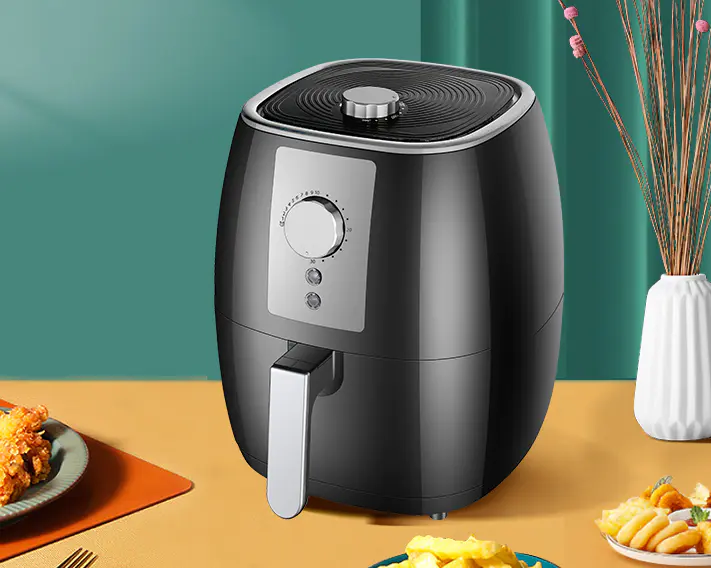
What type of insulation structure is used in the casing of the 5L Manual Air Fryer
I. Core Objectives and Challenges in Insulation Design
The 5L Manual Air Fryer is a high-power kitchen appliance that operates at elevated temperatures, often reaching or higher inside. The design of its exterior insulation structure must achieve two primary goals simultaneously:
-
User Safety Protection: Strictly control the temperature of the appliance's external surfaces to prevent burn hazards upon contact. According to international safety standards (such as IEC 60335-2-9), the temperature rise limits for accessible non-operational surfaces (e.g., side panels) are typically very strict.
-
Energy Efficiency Maintenance: Minimize the internal heat loss to the environment, ensuring that the heat generated by the element is efficiently concentrated within the cooking cavity, thereby shortening cooking time and reducing energy consumption.
For the 5L large-capacity model, the increased cavity volume and higher heat capacity necessitate enhanced insulation requirements.
II. Structural Insulation Barrier: The Double-Wall Casing Design
Professional 5L air fryers predominantly use a Double-Wall Casing design as their primary structural insulation barrier.
Inner Metal Cavity
-
Material: Typically uses high-strength stainless steel (such as SUS304 or SUS430) or high-temperature treated aluminum sheet for the inner cavity wall. These materials possess excellent heat resistance and thermal reflectivity.
-
Function: The inner metal cavity directly withstands the high temperatures and acts as the primary reflection surface, reflecting most of the radiant heat back into the cooking area.
Outer Plastic Shell
-
Material: Usually made from high-temperature resistant, high-impact engineering plastics, such as Flame-Retardant Polypropylene (FR-PP) or Polycarbonate (PC). These materials inherently have a low thermal conductivity.
-
Function: Provides an aesthetically pleasing, easy-to-clean exterior and serves as the final contact surface. Its temperature is the critical metric for user safety perception.
Intermediate Air Gap
A precisely calculated Air Gap (typically 5mm to 15mm) is maintained between the inner and outer layers.
-
Mechanism: Still air is an excellent thermal insulator. This air gap layer minimizes heat conduction from the inner cavity to the outer shell by trapping a relatively stationary layer of air.
-
Design Optimization: The internal design of the air gap avoids the formation of convective loops, preventing air movement within the gap which would otherwise accelerate heat transfer.
III. Application of Thermal Resistance Materials in Key Areas
In addition to the structural double-wall casing, high-efficiency thermal resistance materials are strategically used at critical heat transfer points.
Insulation Wool/Insulating Materials
-
Type: Inorganic insulation materials such as Fiberglass Insulation or Aluminosilicate Fiber are commonly used. These materials feature extremely low density and thermal conductivity (e.g., a thermal conductivity value significantly below ).
-
Application Location: Primarily used to fill the top area (above the heating element) and the bottom area (above the electrical components) where heat is concentrated or sensitive electronics need protection. They provide insulation by limiting both radiation and conduction.
High-Temperature Silicone Seals
-
Location and Function: High-temperature silicone rubber seals are used at the interface where the drawer slides into the main unit.
-
Role: These seals create an airtight barrier, preventing the leakage of hot air through the gaps. This not only avoids localized burn hazards but also prevents heat leakage, which is crucial for energy efficiency.
IV. Structural Thermal Bridges and Ventilation Control
Professional insulation design must address the "thermal bridge effect" and exhaust ventilation.
Minimizing Thermal Bridge Effect
-
Definition: Thermal Bridges are metal components (such as screws, brackets, or slide rails) that connect the hot interior to the cooler exterior shell. They act as major paths for heat conduction.
-
Solution: Engineers maximize the thermal resistance of the heat conduction path by using low-thermal-conductivity materials (like engineering plastics) for connectors or by employing thermal break designs (structuring metal connectors to be thin or discontinuous). This minimizes the thermal bridge effect.
Precise Ventilation and Smoke Exhaust Control
The air fryer's exhaust system plays a dual role in insulation.
-
Smoke and Moisture Exhaust: Vents located at the back or side expel water vapor and minor cooking smoke generated during the process.
-
Localized Cooling: The exhaust path is optimized so that, before exiting the cavity, it can draw away some of the boundary heat accumulated near the exterior shell, providing an auxiliary cooling effect. However, this ventilation must be controlled to avoid unnecessarily drawing away excessive effective cooking heat.