
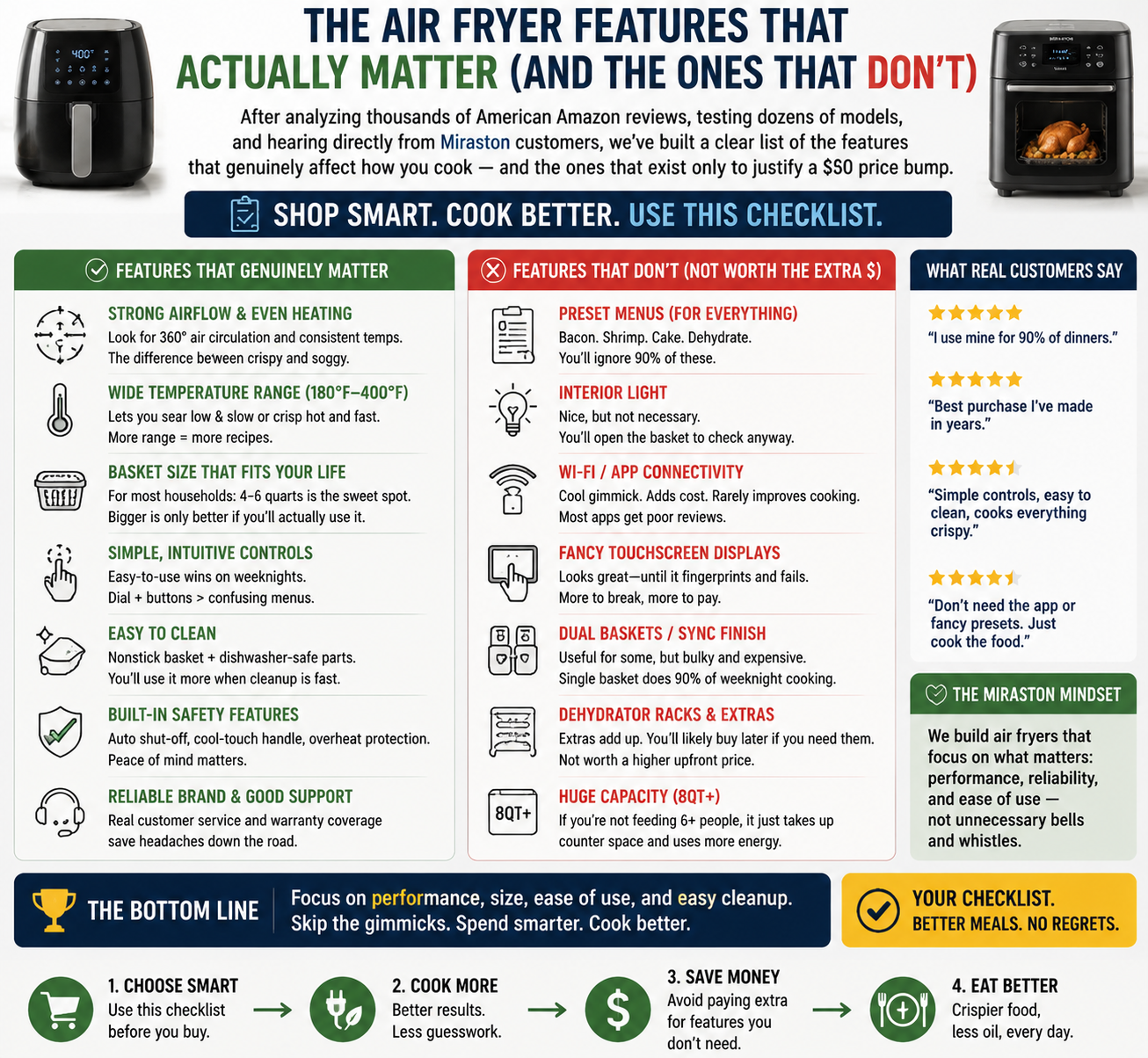
9 Air Fryer Features That Actually Matter in 2026 (And 3 That Are Just Marketing)
Reading time: ~8 minutes
TL;DR — After analyzing thousands of American Amazon reviews, testing dozens of models, and hearing directly from Miraston customers, we've built a clear list of the features that genuinely affect how you cook — and the ones that exist only to justify a $50 price bump. If you're shopping this year, use this as your checklist.
The Air Fryer Market Has a Feature-Creep Problem
Walk into a Best Buy, Target, or scroll Amazon's air fryer category and you'll see units advertising 17 presets, rotisserie modes, built-in cameras, "AI" cooking, and Alexa integration. Meanwhile the reviews for those same units are full of people complaining that the basket is too small or the food comes out soggy.
The disconnect is real: brands compete on feature counts because features fit on a box, while the things that actually matter — airflow design, basket geometry, coating quality — are hard to market.
This guide is written from the opposite direction. We're going to walk through the features that measurably change what comes out of the basket, and the ones that mostly exist to raise the price.
The 9 Features That Actually Matter
1. Basket Capacity (5–8 quarts is the sweet spot)
This is the #1 thing people regret. Every American household we've surveyed says the same thing: "I wish I'd bought a bigger one."
- 3-quart: Single person, small snacks only. You'll outgrow it in three months.
- 5-quart: Two people, no leftovers.
- 6–7 quart: Family of 4, or 2 people with leftovers. The mainstream sweet spot.
- 8 quart+: Family of 5+, or people who meal-prep. Also fits a whole 5 lb chicken.
- Dual zone (2x 4qt): Cooks two foods simultaneously at different temps. Genuinely useful for full meals.
If you cook for more than yourself, do not buy under 6 quarts. Full stop.
2. Viewing Window (Yes, It Actually Matters)
We wrote a whole dedicated post about viewing windows because this feature is more polarizing than it should be. The short version:
Every time you open a windowless air fryer to check food, you drop the internal temperature by 30–50°F and add 1–2 minutes to your cook time. Over a year, that's real energy waste and real overcooking. A viewing window lets you monitor the Maillard reaction visually without opening the basket, and once you've used one, you cannot go back.
3. Wattage (1,500W minimum, 1,700W+ ideal)
Wattage is the single best predictor of how crispy your food will actually get. Lower-wattage units — often 900–1,200W in the ultra-cheap tier — can't sustain high enough temperature during cooking, especially once you add cold food to the basket.
- Under 1,500W: Struggles with frozen food, uneven browning
- 1,500–1,700W: Solid for most home cooking
- 1,700W+: Restaurant-tier crisping, handles frozen straight-to-basket
The Miraston 8-quart runs at 1,700W, which is the reason it browns evenly all the way to the top of the basket.
4. Basket Coating Material
The biggest health concern American shoppers have — legitimately so — is the non-stick coating. Modern quality coatings fall into two categories:
- Ceramic: PFOA-free by definition. Great heat resistance. Slightly less non-stick over time.
- Upgraded PTFE (post-2013 US standard): PFOA-free, PFOS-free. Highly non-stick. Long-lasting if you don't use metal utensils.
Both are safe when used correctly. What to avoid: cheap imported units that don't disclose their coating type, or that ship from third-party sellers without US safety compliance documentation.
Miraston publishes coating specs on every product page and third-party tests every batch.
5. Dishwasher-Safe Basket
Sounds trivial. Isn't. If cleaning takes more than 90 seconds, you will stop using your air fryer within two months. A dishwasher-safe basket is the difference between "we use it every day" and "it's in the pantry."
6. Temperature Range (200°F–450°F)
You want at least this range:
- 200–250°F: Reheat, dehydrate, keep warm
- 300–350°F: Fish, delicate vegetables
- 375–400°F: The everyday sweet spot
- 425–450°F: Deep browning, frozen foods
Units that cap at 400°F are usable but limit your steak, wing, and pizza game.
7. Digital Controls with Precise Adjustments
Analog dials feel retro but are imprecise — most drift 20°F+ from the labeled setting after a year of use. Digital controls with 1°F/1-minute increments hold their calibration and let you dial in recipes exactly.
Presets are nice but overrated (see below). What matters more is that manual mode is fast to access.
8. Cool-Touch Exterior
If you have kids, pets, or a small kitchen where the fryer sits close to other things, this is a safety must. Look for double-walled construction. Cheap single-wall units get hot enough to burn skin on contact.
9. Compact Footprint When Not in Use
An air fryer that lives on the counter gets used. An air fryer that lives in a cabinet gets used twice a year. Look for units under 14" deep so they fit standard countertop depth, and units under 14 lbs so you can move them easily.
The 3 Features That Are (Mostly) Marketing
1. "17 Presets" (or any preset count above 6)
Presets are shortcuts — they don't actually cook differently from manual mode at the same temp/time. Six presets covers 95% of real cooking:
- Fries
- Chicken
- Fish
- Vegetables
- Reheat
- Bake
Every preset beyond that is a marketing bullet point. Nobody uses the "cupcake" preset. It's just 320°F for 15 minutes.
2. Built-In Cameras and App Connectivity
The idea sounds cool: monitor your food from your phone. In practice:
- The camera lens fogs up within 3 minutes
- You still have to physically go to the kitchen to remove food
- The app crashes or the wifi connection fails
- You've added a $100 premium for a feature you use twice
A viewing window on a well-lit unit gives you the same information with zero failure modes.
3. "AI Cooking" / Auto-Adjust Technology
Some 2025–2026 models claim to use "AI" to adjust cooking automatically based on food type. Reality check: this is almost always a weight sensor plus a lookup table. It works okay for standardized frozen products and fails on anything homemade or non-standard.
Manually setting temperature and time takes 4 seconds. You do not need AI for this.
Features Worth Paying Extra For
Ranked by return on investment:
- Bigger basket (7–8 qt vs 5 qt) — worth $30–50 extra
- Viewing window — worth $20–40 extra
- 1,700W+ heating — worth $20 extra
- Dual zone — worth $60–80 extra if you cook full meals regularly
- Verified PFOA-free coating — should be standard, not premium
- Dishwasher-safe basket — should be standard
Features NOT Worth Paying Extra For
- Wifi / app control
- Built-in cameras
- Rotisserie attachments (nobody uses them after week 2)
- Voice control
- Custom color options that cost $30 more
How Miraston's Lineup Maps to This List
We designed our current lineup specifically around the "features that matter" list:
| Model | Capacity | Window | Wattage | Dual Zone | Dishwasher Safe |
|---|---|---|---|---|---|
|
Miraston 6-Qt
|
6 qt
|
✅
|
1,600W
|
❌
|
✅
|
|
Miraston 8-Qt Window
|
8 qt
|
✅
|
1,700W
|
❌
|
✅
|
|
Miraston Dual Zone
|
8 qt total
|
✅
|
1,800W
|
✅
|
✅
|
We deliberately don't ship models with wifi, apps, or cameras. Every dollar of the price goes into build quality, coating grade, and airflow engineering.
A Practical Shopping Checklist
Print this out or screenshot it before you buy:
- Basket ≥ 6 quarts
- Viewing window included
- Wattage ≥ 1,500W (1,700W+ for best crisping)
- PFOA-free coating disclosed on product page
- Dishwasher-safe basket
- Digital controls with 1°F/1-min precision
- Temperature range at least 200–425°F
- Cool-touch exterior
- Under 14 lbs / under 14" deep
- Under $150 if it lacks all of the above; over $150 only if it has most of them
Bottom Line
Air fryers hit their maturity as a product category in 2024. In 2026, there is no reason to accept a small basket, a windowless design, a mystery coating, or a hand-wash-only unit — those are all solved problems. The models still selling with those flaws are relying on the price tag alone to compete.
If you follow this checklist you'll end up with something that lives on your counter for the next decade. Skip it and you'll end up with something in your donation pile by summer.
Ready to Skip the Marketing and Just Get a Good One?
The Miraston 8.5-Qt Viewing Window air fryer was built directly against the checklist in this article — nothing missing, nothing gimmicky. Take a look:
- 🛒 Amazon — {AMAZON_URL}
- 🎵 TikTok Shop — {TIKTOK_URL}
- 👗 SHEIN — {SHEIN_URL}
- 🏬 Walmart — {WALMART_URL}
Still deciding between models? Reach out on our contact page — we'll help you pick based on your household size and cooking style.