Air Fryer Safety, PFOA, and Cleaning: The Honest US Owner's Guide
Reading time: ~8 minutes
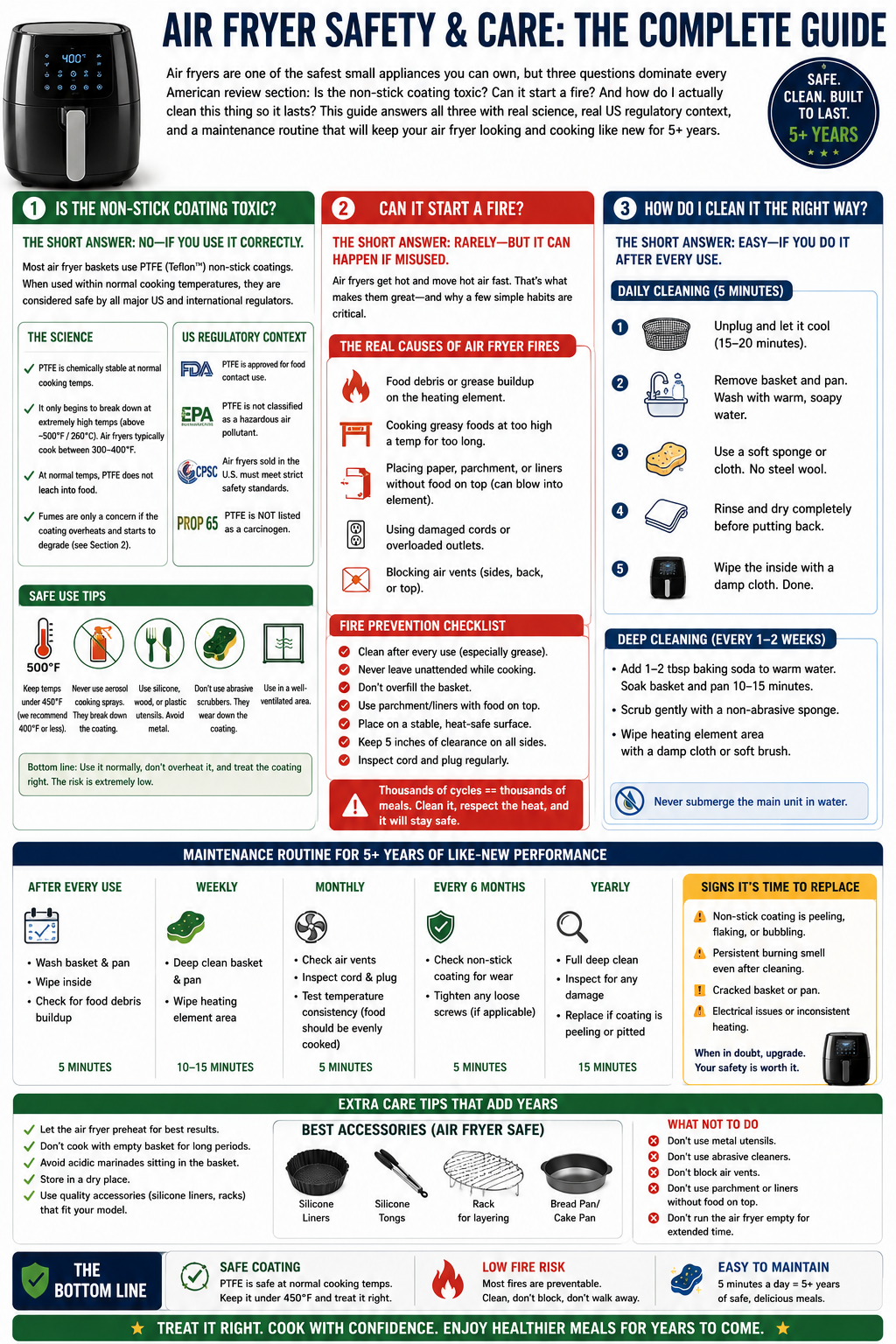
TL;DR — Air fryers are one of the safest small appliances you can own, but three questions dominate every American review section: Is the non-stick coating toxic? Can it start a fire? And how do I actually clean this thing so it lasts? This guide answers all three with real science, real US regulatory context, and a maintenance routine that will keep your air fryer looking and cooking like new for 5+ years.
Part 1: The PFOA / "Toxic Coating" Question
This is the single most-Googled air fryer safety concern in the US, and the confusion is understandable. Let's clear it up systematically.
What is PFOA?
PFOA (perfluorooctanoic acid) is a chemical that was historically used in the manufacturing of PTFE (Teflon) non-stick coatings. It falls into a broader family called PFAS ("forever chemicals") that have been linked to health issues including thyroid disease, certain cancers, and immune effects at industrial-exposure levels.
The critical fact most articles miss
PFOA has been phased out of all US-made cookware since 2013, as part of the EPA PFOA Stewardship Program. Every reputable brand selling in the American market — including Miraston, Ninja, Cosori, Instant, Philips, and others — uses PFOA-free coatings.
Modern non-stick coatings fall into two safe categories:
- Ceramic coatings: Made from silica-based materials. Naturally PFOA-free. Very heat stable up to 700°F+.
- Modern PTFE coatings: PTFE itself (the polymer) is inert and safe when cooked below 500°F. Post-2013 US PTFE is manufactured without PFOA. Stable, non-stick, food-safe.
What actually poses risk?
Two behaviors, and neither is the coating itself:
- Preheating an empty non-stick basket above 500°F for extended periods. This can degrade PTFE and release fumes. Air fryers cap at 400–450°F, so this basically never happens in normal use.
- Using damaged or flaking coatings. If your basket is chipped, scratched, or peeling, replace it. Ingesting coating flakes is unlikely to cause serious harm (they pass through), but the underlying aluminum then contacts food directly.
The Miraston coating disclosure
We publish this on every product page:
- PFOA-free ✅
- PFOS-free ✅
- BPA-free ✅
- Cadmium-free ✅
- Lead-free ✅
- Third-party lab tested per batch
If a brand doesn't openly disclose all five of these, ask why before you buy.
Part 2: Fire and Burn Safety
Air fryers are involved in a small number of household fires each year, and the causes are consistent enough to be easily prevented.
The 4 real fire risks
-
Excess grease buildup. After cooking fatty foods like bacon or wings, grease can accumulate in the drip tray. If left uncleaned, it can smoke or catch fire on the next high-heat cook. Fix: Wipe or wash the drip tray after every fatty cook.
-
Small paper or parchment scraps blowing into the heating element. Never use a piece of parchment paper that isn't weighed down by food. The fan will suck it up into the element. Fix: Only use pre-cut perforated air fryer parchment, always weighted with food.
-
Cooking too close to walls or cabinets. Air fryers exhaust hot air upward and behind. Keep at least 5 inches of clearance from walls, cabinets, and other appliances.
-
Using a damaged power cord or a shared outlet. Air fryers pull 1,500–1,800W. Don't share the outlet with a microwave or toaster on the same circuit.
Burn prevention
The exterior of quality air fryers stays hand-safe, but three surfaces get very hot:
- The basket handle (safe to grip but not to grab bare-handed for extended time)
- The interior chamber (obviously)
- The exhaust vent on the back/top — this is often forgotten. Do not lean over your air fryer mid-cycle.
If you have children, put the unit at the back of the counter and keep the cord tucked. Cool-touch double-wall models like Miraston reduce but do not eliminate hot-surface risk.
Part 3: The Cleaning Routine That Makes Your Air Fryer Last
Poor cleaning is why most air fryers get replaced within 2 years. Follow this routine and yours will last a decade.
After every cook (2 minutes)
- Unplug and let cool for 10 minutes.
- Remove the basket and drip tray.
- Wash both in warm soapy water (or run through the dishwasher if your model is dishwasher-safe — Miraston's are).
- Wipe the interior chamber with a damp microfiber cloth.
- Air-dry all parts fully before reassembly.
That's it. Two minutes. Do it every single time and you never need "deep cleaning."
Weekly (5 minutes)
- Check the heating element at the top of the chamber. If you see grease splatter, wipe with a damp cloth once cool. Never scrub — you'll damage the element.
- Wipe the exterior with a soft cloth.
- Empty the drip tray even if you didn't cook anything greasy.
Monthly (10 minutes)
- Deep clean the basket by soaking in warm water + dish soap for 15 minutes if any residue remains.
- Inspect the coating for any chips, scratches, or wear. If any coating damage exists, order a replacement basket.
- Check the rubber feet on the base — replace if worn.
- Vacuum the vents on the back with a small brush attachment to prevent dust buildup on the fan.
The 7 Cleaning Mistakes That Damage Your Air Fryer
Mistake 1: Steel wool or abrasive scrubbers
Destroys the coating instantly. Use only soft sponges or dishcloths. If food is stuck, soak longer — don't scrub harder.
Mistake 2: Metal utensils in the basket
Same reason. Silicone, wood, or nylon only.
Mistake 3: Submerging the main unit
The base of the air fryer contains electronics. Never dunk it in water. Wipe only.
Mistake 4: Cleaning while still hot
You can warp components and burn yourself. Wait 10 minutes.
Mistake 5: Using oven cleaner or harsh chemicals
The chemicals degrade the coating over time and can leave residue that transfers to food. Dish soap is sufficient for 99% of buildup.
Mistake 6: Skipping the drip tray
The most-forgotten part. It collects all the grease that would otherwise smoke on the next cook.
Mistake 7: Storing while damp
Reassembling before parts dry traps moisture and can lead to rust or coating breakdown. Air-dry fully.
Part 4: When to Replace Parts vs. the Whole Unit
Replace just the basket if:
- Coating is chipped, flaked, or scratched
- Basket handle is loose
- Non-stick performance has degraded (food constantly sticks despite oil)
Most quality brands (including Miraston) sell replacement baskets for $20–35. Do this before assuming the whole unit is dead.
Replace the whole unit if:
- The heating element makes buzzing or arcing sounds
- The fan is loud, wobbly, or rattling
- Temperatures are inaccurate by 20°F+ (test with an oven thermometer)
- The exterior gets dangerously hot (double-wall insulation has failed)
- The unit is 5+ years old and shows multiple issues
Signs you should replace immediately (safety)
- Any visible damage to the power cord
- Smoke coming from the base (not the food)
- Burnt-plastic smell from the housing
- Repeated tripping of your circuit breaker
Part 5: Food Safety Specifics
A few American-specific concerns worth addressing:
Reheating chicken and seafood
Air fryer reheating is genuinely better than microwave for food safety because it hits and holds high temperatures. Reheat leftover chicken to 165°F internal. Fish reheats best at 350°F for 3–4 minutes.
Cross-contamination
The basket is easy to keep clean because it's dishwasher-safe. But be conscious of:
- Cooking raw chicken and vegetables in the same cycle without a divider
- Using the same tongs for raw and cooked food
A dual-zone air fryer solves the first issue directly.
Cooking bacon
Safe and delicious in the air fryer, but expect grease buildup. Line the drip tray with a small amount of water or a folded paper towel to absorb splatter, and clean immediately after.
Reheating rice
Do not reheat rice in the air fryer — dry heat overcooks the outside while the inside stays cold, and rice has its own bacterial concerns (Bacillus cereus) that require even reheating. Use a microwave or stovetop for rice.
The Bottom Line on Air Fryer Safety
Air fryers are one of the safest countertop appliances in your kitchen — safer than a deep fryer (no hot oil), safer than a slow cooker left unattended for 8 hours, and easier to keep clean than an oven. The two things that create almost every complaint (toxic coating fears, fire risk) are essentially solved problems for any reputable US-market brand from the last five years.
Buy from a company that publishes its coating specs. Clean the basket after every cook. Replace the basket if it chips. Give the unit space on the counter. That's the entire safety and longevity playbook.
The Miraston Promise
Every Miraston air fryer ships with:
- PFOA-free, PFOS-free, BPA-free
- Cool-touch double-wall exterior
- Dishwasher-safe basket and drip tray
- Auto shutoff and overheat protection
- 1-year US warranty
Pick your platform and shop the lineup:
- 🛒 Amazon — {AMAZON_URL}
- 🎵 TikTok Shop — {TIKTOK_URL}
- 👗 SHEIN — {SHEIN_URL}
- 🏬 Walmart — {WALMART_URL}
Questions about a specific safety concern? Reach us via the contact page — real humans, real responses.