
Air Fryer vs. Oven vs. Deep Fryer: Which Actually Wins in an American Kitchen?
Reading time: ~8 minutes
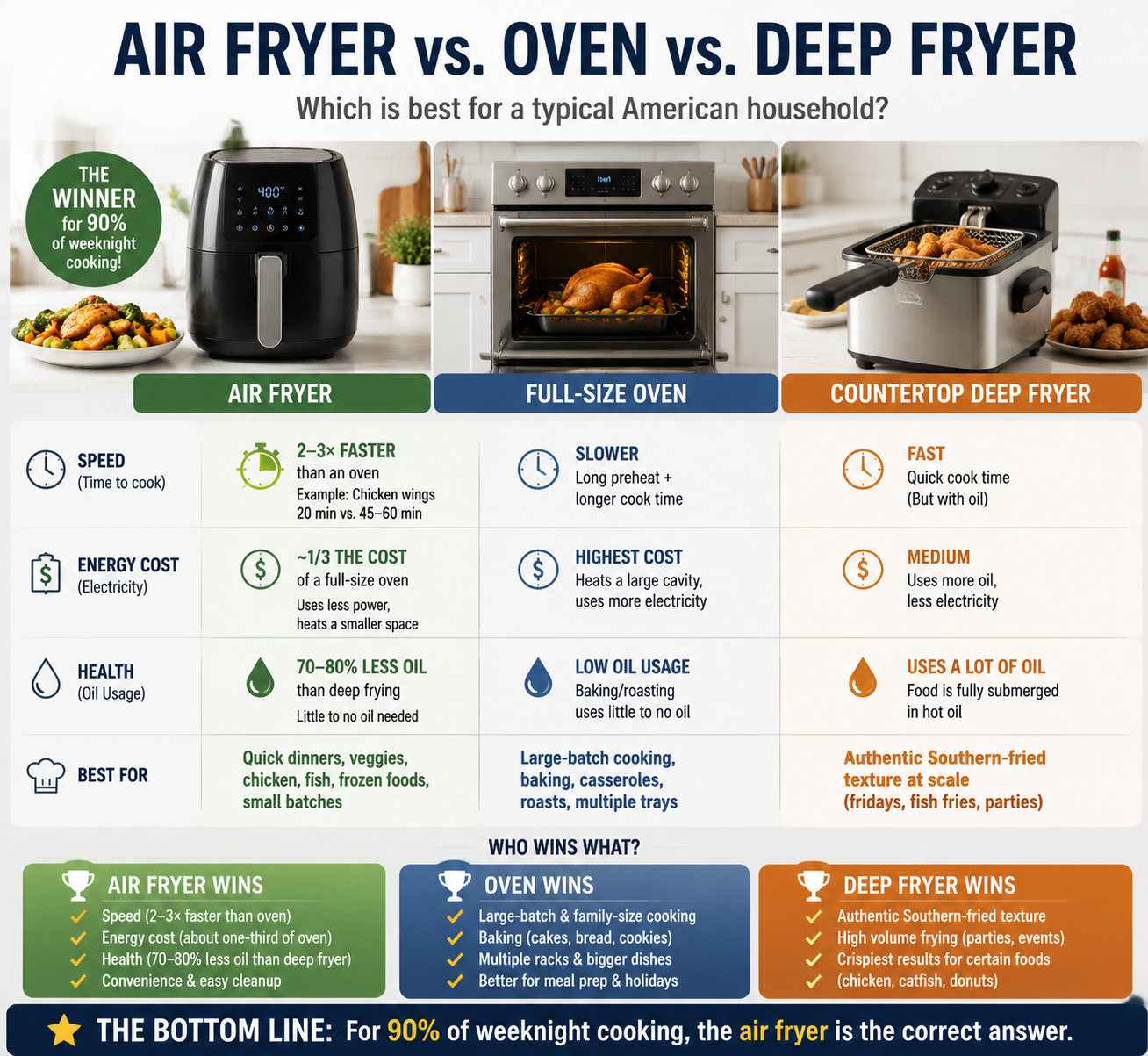
TL;DR — If you're comparing an air fryer, a full-size oven, and a countertop deep fryer for a typical American household, the air fryer wins on speed (2–3× faster than an oven), energy cost (roughly one-third of an oven's electricity), and health (70–80% less oil than a deep fryer). The oven still wins for large-batch cooking and baking. The deep fryer wins for exactly one thing: authentic Southern-fried texture at scale. For 90% of weeknight cooking, the air fryer is the correct answer.
Why This Comparison Matters More Than Ever
The average American kitchen is getting smaller, not bigger. New apartment builds in Austin, Denver, Phoenix, and pretty much every growing metro are trending toward compact galley kitchens. Meanwhile, electricity prices are up double digits in most states over the last three years, and no one wants to preheat a 30-inch oven for 20 minutes just to bake four chicken tenders.
That's the real reason this appliance debate keeps trending. It's not about which one cooks best in a lab. It's about which one actually fits how you cook Tuesday through Thursday — and how much it costs to run every single time.
Let's put all three on the table.
Round 1: Speed
Air fryer: 3–5 minutes preheat, then 8–15 minutes for most weeknight foods. Conventional oven: 10–15 minutes preheat, then 20–45 minutes cook time. Deep fryer: 8–12 minutes to heat oil, then 3–8 minutes cook time (fast — but see the cleanup section).
For a typical batch of chicken wings:
- Air fryer: ~22 minutes total
- Oven: ~50 minutes total
- Deep fryer: ~18 minutes cook time, but 30 minutes of oil heating + cooling + straining afterward
Winner: Air fryer, by a wide margin for realistic weeknight math.
Round 2: Energy Cost
This one surprised us when we ran the numbers. Using US average electricity price of $0.17/kWh (2026 EIA data) and running each appliance for a typical 20-minute weeknight cook:
| Appliance | Wattage | Time | Cost per meal |
|---|---|---|---|
|
Air fryer (7 qt)
|
1,700 W
|
20 min
|
~$0.10
|
|
Electric oven
|
2,400 W
|
45 min*
|
~$0.31
|
|
Deep fryer
|
1,800 W
|
20 min
|
~$0.10 (plus $8–15 in oil)
|
|
Gas oven
|
~30k BTU/hr
|
45 min
|
~$0.20
|
*Oven time includes preheat, which the other two barely need.
Over a year of daily use, switching from oven to air fryer for weeknight dinners saves the average family $75–110 on their utility bill — small but real. The bigger deep fryer cost is oil replacement: quality frying oil is $8–15 per fill-up, and it should be replaced every 6–8 uses if you care about flavor and safety.
Winner: Air fryer.
Round 3: Food Quality
This is where it gets more nuanced. Let's break it down by food category.
Frozen breaded foods (fries, nuggets, mozzarella sticks, tenders)
- Air fryer: Excellent. Genuinely rivals deep frying for crispness.
- Oven: Mediocre. Bottom stays soft, top over-browns.
- Deep fryer: Best-in-class crispness, but you're eating 3× the fat.
Winner: Air fryer (best texture-per-calorie ratio).
Fresh chicken thighs, drumsticks, wings
- Air fryer: Crispy skin, juicy interior, no flipping needed. Best of all three.
- Oven: Good, but requires broiler finish for crispy skin.
- Deep fryer: Great for wings, overkill for thighs.
Winner: Air fryer.
Steaks and thick cuts
- Air fryer: Decent for smaller cuts. Not ideal for 2-inch ribeyes.
- Oven: Best for reverse-sear method.
- Deep fryer: No.
Winner: Oven.
Baking (cookies, breads, cakes)
- Air fryer: Possible but capacity-limited. Fine for a cookie or two.
- Oven: The obvious winner.
- Deep fryer: Absolutely not.
Winner: Oven.
Vegetables (Brussels sprouts, broccoli, sweet potato)
- Air fryer: Life-changing. Genuinely the best method for crispy vegetables.
- Oven: Good, but requires 25+ minutes and higher temps.
- Deep fryer: Waste of oil.
Winner: Air fryer.
Whole roasted chicken, turkey, prime rib
- Air fryer: Only if you have a 7 qt+ unit. Miraston's larger models handle a 5–6 lb bird beautifully.
- Oven: The standard.
- Deep fryer: Turkey fryers exist but require outdoor use and are a fire hazard.
Winner: Oven for anything over 6 lbs, air fryer for smaller birds.
Round 4: Health
We covered this in depth in our post on whether air fryers are actually healthy, so the short version:
- Air fryer: 70–80% less fat than deep frying, up to 90% less acrylamide, no seed-oil byproducts.
- Oven: Similar to air fryer for most foods, slightly more oil often needed to prevent sticking on sheet pans.
- Deep fryer: Highest fat and acrylamide content of the three by a wide margin.
Winner: Tie between air fryer and oven, with deep fryer clearly last.
Round 5: Cleanup and Maintenance
This is where the deep fryer really loses.
Deep fryer cleanup:
- Let oil cool completely (30–60 min)
- Strain through cheesecloth
- Store in a sealed container
- Wipe down the fryer body and heating element
- Deal with lingering fried-food smell in your kitchen for 12 hours
Oven cleanup:
- Wait for it to cool
- Scrub baked-on drips (or run self-clean, which uses another 3+ kWh)
- Wipe racks
Air fryer cleanup:
- Remove basket
- Toss it in the dishwasher (if dishwasher-safe — Miraston baskets are)
- Wipe the interior with a damp cloth
- Done in 2 minutes
Winner: Air fryer, not even close.
Round 6: Kitchen Footprint
A modern 6–8 quart air fryer takes up roughly the same counter space as a coffee maker. A deep fryer takes similar space but has to be stored somewhere between uses because of the oil. An oven is built in — no footprint tradeoff, but no portability either.
If you rent, move often, or have a small kitchen (hello, NYC and SF readers), the air fryer is the clear pick.
The Honest Verdict
| Criterion | Air Fryer | Oven | Deep Fryer |
|---|---|---|---|
|
Speed
|
★★★★★
|
★★
|
★★★★
|
|
Energy cost
|
★★★★★
|
★★★
|
★★★
|
|
Food quality (weeknight)
|
★★★★★
|
★★★
|
★★★★
|
|
Food quality (baking/large cuts)
|
★★
|
★★★★★
|
★
|
|
Health
|
★★★★★
|
★★★★
|
★★
|
|
Cleanup
|
★★★★★
|
★★★
|
★
|
|
Footprint
|
★★★★
|
N/A
|
★★
|
The right answer for most American households: Keep the oven you already have for holidays, baking, and large cuts. Add an air fryer for everything else. Skip the deep fryer entirely — or use it 3 times a year for a state fair moment.
What to Look for in Your Air Fryer
If you're going to replace 80% of your oven use with an air fryer, don't buy the cheapest 3-quart model on the shelf. Look for:
- 3–10 quart basket (or dual zone) so you can cook family meals in one batch
- Viewing window so you can monitor food without opening and losing heat
- 1,500+ watts for genuine crisping power
- Digital presets including fish, vegetables, and reheat
- PFOA-free, dishwasher-safe basket
- Cool-touch exterior if you have kids or a small kitchen
Miraston's 8.5-quart viewing-window model was engineered around this exact spec list — we built it after reading thousands of American reviews complaining that their old air fryers were too small, too loud, or too hard to monitor.
Bottom Line
You already own an oven. You probably don't need a deep fryer. The kitchen upgrade that actually changes how you cook is a good air fryer — and the "good" part matters. A 3-quart bargain unit will end up in the closet within six months. A well-designed 8-quart with a viewing window will replace 4–5 of your other appliances and pay for itself in a year on takeout savings alone.
Get the Miraston Air Fryer
Available on all major US platforms — pick the one you already shop on:
- 🛒 Amazon — {AMAZON_URL}
- 🎵 TikTok Shop — {TIKTOK_URL}
- 👗 SHEIN — {SHEIN_URL}
- 🏬 Walmart — {WALMART_URL}
Still not sure which Miraston model is right for your kitchen? Our Air Fryer Buying Guide breaks down every feature that actually matters.