Are Air Fryers Actually Healthy? Here's What the Science (and 5 Years of American Kitchens) Says
Reading time: ~7 minutes
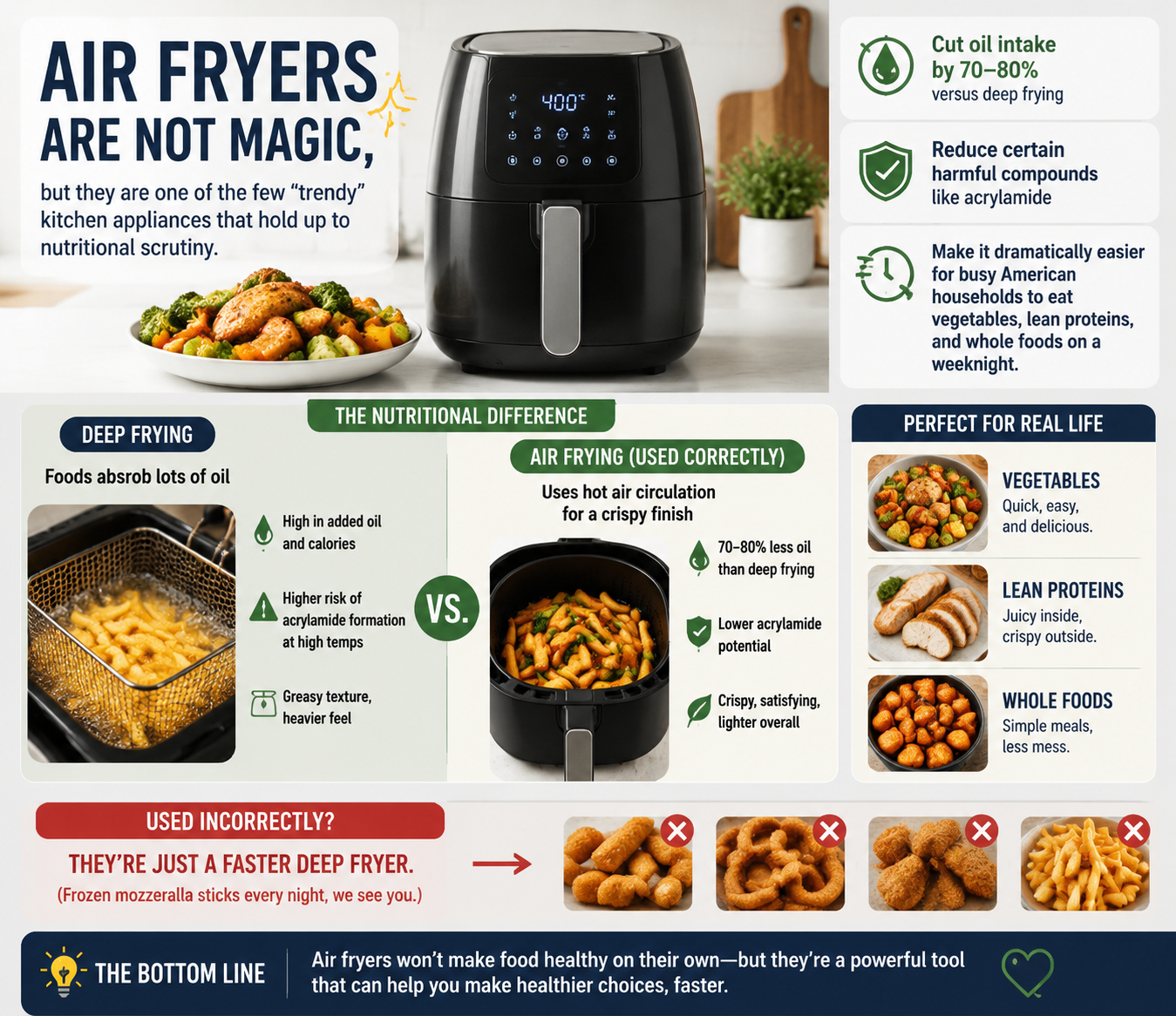
TL;DR — Air fryers are not magic, but they are one of the few "trendy" kitchen appliances that hold up to nutritional scrutiny. Used correctly, they can cut oil intake by 70–80% versus deep frying, reduce certain harmful compounds like acrylamide, and make it dramatically easier for busy American households to eat vegetables, lean proteins, and whole foods on a weeknight. Used incorrectly (frozen mozzarella sticks every night, we see you), they're just a faster deep fryer.
Why Americans Suddenly Care About Air Fryers Again
If you walked into ten random US kitchens in 2019, maybe two had an air fryer. Today, that number is closer to six out of ten according to industry surveys, and it's still climbing. The reason isn't just TikTok — although TikTok certainly helped. The real driver is that Americans are quietly rewriting how they cook at home.
We're eating out less. We're trying to hit protein goals. We're watching seed oils, sodium, and ultra-processed food more closely than any generation before us. And we still want dinner on the table in 20 minutes.
The air fryer sits neatly at the intersection of all of that. But does it actually deliver on the health promise? Let's go through the evidence, honestly.
What an Air Fryer Actually Does (Hint: It's Not Frying)
An air fryer is essentially a compact convection oven with an aggressive fan and a tightly designed cooking chamber. Superheated air (usually 350–400°F / 175–205°C) circulates around your food at high velocity, dehydrating the surface and triggering the Maillard reaction — the same browning process that gives you crispy chicken skin, seared steak crust, and golden fries.
Because the crisping happens through hot air and the food's own moisture, you need very little added oil. In many cases you need none at all. That single mechanical fact is where nearly all of the health benefits come from.
The Real Health Wins, Ranked by How Much They Actually Matter
1. Massive Reduction in Added Oil (This Is the Big One)
Deep frying a batch of French fries submerges them in oil, and depending on cut and temperature, the potato can absorb 10–25% of its weight in oil. A medium serving of restaurant fries can carry 15–20 grams of fat, most of it from refined seed oils that have been reused multiple times.
The same fries in an air fryer? You use about 1 teaspoon of oil for the whole batch — sometimes zero if the potato is fresh. Studies published in the Journal of Food Science and elsewhere consistently find 70–80% less fat content in air-fried versus deep-fried versions of the same food.
For the average American consuming 2,000 calories a day, replacing three deep-fried meals a week with air-fried versions can quietly remove 1,500+ calories per week without changing portion sizes or ingredients. That's real, sustainable weight management math.
2. Lower Acrylamide Formation
Acrylamide is a compound that forms when starchy foods (potatoes, bread) are cooked at high temperatures, and it's been flagged by the FDA and IARC as a probable carcinogen. Deep frying is one of the worst offenders because of the sustained high heat and oil interaction.
Air frying, thanks to shorter cook times and dry heat, produces up to 90% less acrylamide in fries and similar starchy foods according to a widely cited 2015 study. It's not zero — no high-heat cooking method is — but it's a meaningful improvement.
3. Better Compliance With Vegetables and Lean Protein
This one doesn't show up in lab studies, but it might be the most important effect. Ask any air fryer owner what they cook most and you'll hear the same list:
- Brussels sprouts (finally crispy, not soggy)
- Broccoli with parmesan
- Chicken thighs and breasts
- Salmon fillets
- Sweet potato wedges
- Whole small cauliflowers
Notice a pattern? These are the foods American dietary guidelines have been begging us to eat for 30 years. The air fryer makes them taste good enough that people actually eat them on a Tuesday night after work. That's a public health win that no lab can measure.
4. Fewer Toxic Byproducts of Reused Oil
Restaurant deep fryers reuse oil for days, sometimes weeks. That oil oxidizes, polymerizes, and forms trans fats and aldehydes with each cycle. If you're air frying, this problem literally does not exist. There is no oil bath to degrade.
Where Air Fryers Don't Make Food Healthier
Let's be honest about the ceiling here.
- Frozen breaded foods are still frozen breaded foods. A frozen mozzarella stick is 300 calories of refined flour, sodium, and industrial cheese whether you fry it in oil or crisp it in air. The air fryer doesn't turn processed food into whole food.
- Portion size still matters. It's easier to eat a whole basket of air-fried fries because they "feel healthy." Calories are still calories.
- Some nutrients (like fat-soluble vitamins A, D, E, K) actually need a little fat to be absorbed. If you're air frying spinach or carrots with zero oil, add a drizzle of olive oil after cooking so your body can use the vitamins.
The PFOA / Non-Stick Coating Question
This comes up in almost every American Amazon review, so let's address it directly. Older non-stick coatings used PFOA, a chemical that has been phased out of US-made cookware since 2013. Modern quality air fryers — including the Miraston lineup — use PFOA-free, PFOS-free ceramic or upgraded PTFE coatings that are stable at normal cooking temperatures.
Two rules keep any non-stick surface safe:
- Don't preheat empty for extended periods
- Don't use metal utensils that scratch the coating
If your basket ever chips or flakes, replace it. Miraston baskets are dishwasher-safe and rated for 400°F daily use.
A Realistic Weekly Menu That Uses the Air Fryer Right
Here's what "healthy air fryer use" actually looks like for a typical American family:
| Day | Meal | Time |
|---|---|---|
|
Mon
|
Air-fried salmon + asparagus
|
12 min
|
|
Tue
|
Chicken thighs + sweet potato wedges
|
18 min
|
|
Wed
|
Turkey meatballs + roasted zucchini
|
15 min
|
|
Thu
|
Shrimp tacos with air-fried peppers
|
10 min
|
|
Fri
|
Frozen fries + burgers (yes, treat night)
|
15 min
|
|
Sat
|
Bacon + eggs + hash browns (weekend breakfast)
|
12 min
|
|
Sun
|
Whole roasted cauliflower + steak bites
|
20 min
|
No deep frying. No takeout. Roughly 15 minutes of active cooking per meal.
What to Look For in a Healthy-Cooking Air Fryer
If you're evaluating whether your current unit is up to the job — or shopping for one — the health-relevant features are:
- Basket capacity of 5–8 quarts so you can actually cook a family meal in one round (small units force you into unhealthy takeout when you're pressed for time)
- A viewing window so you don't have to keep opening the basket and losing heat — this matters for even cooking without oil (here's the deeper dive we wrote on windows)
- PFOA/BPA-free coating confirmed on the spec sheet
- Dishwasher-safe basket because you'll actually clean it if it's easy
- Digital presets for fish, vegetables, and lean protein, not just "fries" and "wings"
Miraston's dual-zone and viewing-window models were built around exactly this checklist.
Bottom Line
Air fryers are one of the rare kitchen trends that actually deserves the hype — if you use them to replace deep frying and takeout, not to fry more processed food faster. Get one with enough capacity for your household, put real ingredients in the basket, and you'll see the health benefits within a month.
Ready to Upgrade?
The Miraston air fryer family is designed for exactly the American home cook this article describes — big enough for a family, PFOA-free, dishwasher-safe basket, and a viewing window so you can watch your dinner crisp without losing heat.
Available now on your favorite platform:
- 🛒 Buy on Amazon —
- 🎵 Shop on TikTok Shop —
- 👗 Shop on SHEIN — https://us.shein.com/store/home?contentIds=&pageType=topBanner&store_code=8626147023&tab=items
- 🏬 Buy at Walmart — {WALMART_URL}
Have a favorite healthy air fryer recipe? Tag us on TikTok — the best ones get featured on our page.